

Heritage Spotlight
The Folk Culture of Turkey
The story of Turkey begins as early as the Stone Age, and as such the country has a rich and extensive history of folklore and folklife. It reflects the history of the region, where Anatolia (or Asia Minor) comprised the Asian half of the country and Eastern Thrace comprised the European half, the history of the Turkish people themselves, and the influence of the Islamic religion. Some of the best documented forms of folklore and folklife include Turkish customs and traditions, stories, folk heroes, music, dance and art—and it is those that we will highlight here.
Perhaps the most famous Turkish tradition (which has also become a popular souvenir of the region) is the use of the Boncuk, a glass stone with the image of an eye painted at the center that is said to protect one from the “Evil Eye.” This mysterious evil force, which spawned from a Turkish folk tale, is often blamed for sickness, death, and other unfortunate events.
Other important aspects of Turkish folklore are folk tales, legends and jokes, many of which are centered on different folk heroes. Perhaps the most common of these is Nasreddin Hoca, a folk figure who at first appears to be comical, but actually reveals the foolishness of others through a variety of witticisms and sayings. Another popular figure is Karagöz, who is often featured in shadow puppetry. Although the stories typically represent Karagöz as a jester character outsmarting his richer, more self-important friend Hacivat, these two characters are supposedly based off of real men who worked on the construction of the Bursa Ulu Mosque. Legend has it that their satirical humor was so distracting that the two were ultimately sentenced to death by the sultan, although their stories and wit were never forgotten. More famous forms of Turkish folklife can be found in the arts. There are several traditional folk dances practiced in Turkey. Some of the most popular are the Horon, a fluid dance performed only by men that originates from the Black Sea region, the Kasik Oyunu or “Spoon Dance” which is performed by both men and women holding wooden spoons, and the Kilic Kalkan, a military danced that celebrates the conquest of Bursa by the Ottomans.
Folk music is a popular genre in Turkey. Turkish folk songs called “türkü” are written about the experiences of daily life and typically tell a story. Like most folk music, the songs are anonymous and passed on by word of mouth. Performers will often improvise by changing around traditional lyrics or adding new lyrics, so that the songs exists in different forms. Türkü are performed with a variety of stringed, wind, and percussion instruments, including the saz, which is similar to a lute with a long neck, the Qanún which resembles a dulcimer, the clarinet-like sipsi, and the Tulum, a type of bagpipe without a drone (a pipe that produces a single note for harmony). Folk music is performed in Turkey every day for celebrations, religious ceremonies, or for simple entertainment, but has also more recently been commercialized by a new generation of recording artists.
Turkish arts and crafts are perhaps the only form of Turkish folklife to achieve international acclaim. Some of the oldest Turkish art forms include calligraphy, a primarily Ottoman tradition that was practiced even on commonplace records; glass art, which originated from the Turks in central Asia and was further developed by the Ottomans; and ceramics, an Anatolian tradition that began as early as the 13th century. Turkish carpets are considered some of the finest in the world, and the tradition of carpet-weaving in Turkey began at as early as 300 BC. Rugs were woven to reflect the life experiences of the weavers, and different forms emerged as the Turkish people migrated and expanded their territories, incorporating new designs and new cultural influences.
Heritage Exhibitors
Artist in Residence: Dilek Demirors
 Dilek Demirors is an Ebru (The Turkish Art of Marbling) artist. Ebru is the art of creating colorful patterns by sprinkling and brushing color pigments on a pan of oily water and then transforming this pattern to paper. She took Ebru lessons from famous Ebru artists in Istanbul. She has been working as a professional Ebru artist for 6 years. She joined many festivals and activities. She has several courses and workshops to teach Ebru. Paper marbling, widely practiced in Turkey, is a method of aqueous surface design, which can produce patterns similar to smooth marble or other stone. The patterns are the result of color floated on either plain water or a viscous solution known as size, and then carefully transferred to an absorbent surface, such as paper or fabric.
Through several centuries, people have applied marbled materials to a variety of surfaces. It is often employed as a writing surface for calligraphy, and especially book covers and endpapers in bookbinding and stationery. Part of its appeal is that each print is a unique monotype. There are several methods for making marbled papers. A shallow tray is filled with water, and various kinds of ink or paint colors are carefully applied to the surface with an ink brush. Various additives or surfactant chemicals are used to help float the colors. A drop of “negative” color made of plain water with the addition of surfactant is used to drive the drop of color into a ring. The process is repeated until the surface of the water is covered with concentric rings. The floating colors are then carefully manipulated either by blowing on them directly or through a straw, fanning the colors, or carefully using a human hair to stir the colors.
Elizabeth Baumgardt
 Elizabeth Baumgardt – more commonly known as Bette – and her family has always done several kinds of needlework, so it was a natural for Bette to fall in love with the beauty of Hardanger Embroidery when a Norwegian friend introduced her to the work many years ago. She was teaching a class at Noreg Lodge, Sons of Norway and when she could no longer do it, Bette took over the class. She finds it very rewarding to see this lovely traditional work being kept alive for future generations to enjoy. Her work has been displayed at the New Jersey’s ScanFest for several years and her designs – most of which are original – have won ribbons in several competitions. Bette is currently an instructor in Haranger for the cultural program at Noreg Lodge and would love to extend a welcome to others who would like to enjoy this lovely work.
Tommy Burke
 Tommy Burke is an oyster farmer presently working with Sloop Point Oyster Company–a collection of shellfish farms specializing in the sustainable production of oysters for consumption. From the time they are planted to the time they head to market, Sloop Point’s oysters are both meticulously cared for by hand and surface-grown–a practice which produces a “clean, well-formed, deep cupped oyster that is gently tumbled by the rolling sea.” With their oyster grounds directly adjacent to wildlife preserves, the company’s oysters are grown in complete harmony with nature in the clean waters of the Barnegat Bay, a body of water once coveted for its abundance of high-quality wild oysters. The wild stocks have been decimated, but Mr. Burke and other oyster farmers are on a mission to revive the tradition of oystering on Barnegat Bay.
Mary May
 Based in Forked River, NJ, Mary May is a specialist in white oak basketry and other basket-making traditions of South Jersey who has been making baskets for over 20 years. Ms. May’s baskets are both strong enough to be used for their historical purposes (carrying berries, fish, eels, etc.) and to be put on display, as they have been at Tuckerton Seaport and the New Jersey State Museum. Ms. May has also demonstrated her craft at New Jersey Forestry Interpretive Center and the Long Beach Island Foundation of the Arts and Sciences, as well as on television programs such as Ebru TV’s “Blank Canvas.” In an effort to preserve and promote white oak and other traditional forms of basket-making, Ms. May teaches workshops regularly at the Jersey Shore Folklife Center, where she serves on the advisory board. Her extensive research and mastery of her craft landed her a 2016 Folk Arts Apprenticeship Grant and title of Master Artist of White Oak Basketry from the New Jersey State Council on the Arts.
Natalie Warchola
 Natalie Warchola is proprietor and lead event floral designer at Warchola’s Holiday Design where she teaches the art of Pysanky. Warchola learned how to create Pysanky as a child, using the traditional wax resist method. As an adult, she perfected her skills as a Pysankar and went on to teach this art by invitation at libraries, schools, and churches. Today, Warchola regularly holds classes and workshops in her studio for those who come to learn how to create Pysanky.
Cooper Rosner
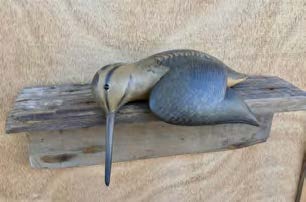 Cooper Rossner learned the craft from JP Hand of Cape May County, “a true friend and mentor to me and is the real deal,” as Rossner states. Hand taught Rossner to carve a true gunning decoy, made with hand tools and built for use. He hunts the marshes and sounds of Cape May County with all carved, floating stools and he wouldn’t have it any other way. Some other inspirations along Rossner’s path have been the likes of Hurricane Pete Peterson, Ken Marshall, George Strunk, Sean Sutton, Jerry Talton, and Chase Luker.
Toby Kroll
 Toby Kroll is a 3rd generation blacksmith/farrier. His job as a boy was to help his father and grandfather with their daily work. Some of Kroll’s earliest memories of farriership is helping to keep the horse comfortable and fly free during the shoeing process. He was an active, full-time farrier for more than 40 years, working for and learning techniques from Bruce Daniels of Mullica Hill, NJ and Donald Streeter of Vineland NJ.
Stephen Nuttall
 Always trying to improve his technique, Apprentice Blacksmith Stephen Nuttall is based in Southern Ocean County and is a 2017 Folk Arts grant recipient from the New Jersey State Council of the Arts. Stephen began his apprenticeship in 2015 under Master Blacksmith Toby Kroll at Basto Village and is forging a deeper relationship with his community by recreating historic items necessary for the Baymen’s life on the Jersey Shore. Stephen is working with the Tuckerton Seaport to install a new Blacksmith ship in Tuckerton, NJ where classes and full-time exhibitions will be presented during special occasions.
Alissa Caldwell
 Alissa Caldwell was born in Newark in 1966, the only child of two childhood sweethearts from a small town in Alabama. A licensed cosmetologist with an Associate’s degree in Fashion Merchandising and Management, Ms. Caldwell is a current student of theology at the Mount Calvary Missionary Church here in New Brunswick. She enjoys working with “many different types and textures of hair of people from all races, creeds and colors,” but especially enjoys doing “ethnic braids, twists, locks, pressing hair, coloring hair, and transitional styles,” among which are many of the styles she will be demonstrating at the Festival.
Dana Perrotti
 Dana Perrotti is a formally-trained metalsmith with a passion for leatherwork. She practices traditional methods of leatherworking, utilizing very sharp knives and specifically-designed hand tools to achieve each step. Through apprenticing with master craftswomen, she learned the art of handsewn shoemaking. A handsewn shoe is made to measure and involves over 40 hours and 200 individual steps to achieve completion. Perrotti is also a committed community educator. She is passionate about bring art into the lives of those around her, and she proudly dedicates herself to passing down traditional techniques to new generations.